
Macon Youth Release Path
Macon Youth Development Campus operates within the Georgia Department of Juvenile Justice system. Release can involve return to a parent or guardian, placement approved by DJJ, community supervision, transfer within the juvenile system, or another result directed by the juvenile court. The exact route depends on the youth's case and authorization. Public adult-corrections terminology should not be imposed on it.
A transfer is not necessarily a community release. Nor does absence from one location prove that DJJ custody ended. The youth's DJJ case contact and the appropriate juvenile court can explain the authorized disposition to a person entitled to receive it. A disposition is the juvenile-court outcome that sets the legal response and placement.
| Question | Proper source |
|---|---|
| Is an authorized release planned? | Assigned DJJ contact or authorized facility contact |
| What did the court order? | Appropriate juvenile court through permitted access |
| Was the youth transferred? | DJJ through an authorized inquiry |
| Who may receive details? | DJJ or court under applicable confidentiality rules |
Confirm a Youth Release
There is intentionally no public name-search workflow offered here for youth. The adult Bibb County jail search, GDC offender search, public mugshot routes, and adult release-list methods are not appropriate substitutes. They serve different populations and operate under different access rules. A lack of results in those systems says nothing reliable about a youth's status.
- Confirm that the requester is authorized to receive information about the youth.
- Use the assigned DJJ case contact or the official campus route to ask where the inquiry belongs.
- Provide the case or identifying information only through the secure method the agency specifies.
- Contact the appropriate juvenile court if a court order or disposition must be confirmed.
- Ask what documentation can lawfully be shared and how it will be delivered.
- For urgent safety or legal concerns, use the responsible agency or counsel rather than a public web search.
Macon Youth Authorized Contact
The official DJJ location material identifies the campus at the address below. Research did not provide a verified phone number or public records hours for this facility. Those details should not be guessed. Use the current Macon Youth Development Campus location page for agency-approved contact information.
Macon Youth Development Campus4160 Riggins Mill Road
Macon, GA 31217
Operator: Georgia Department of Juvenile Justice
The official location page is shown in the matched capture below.
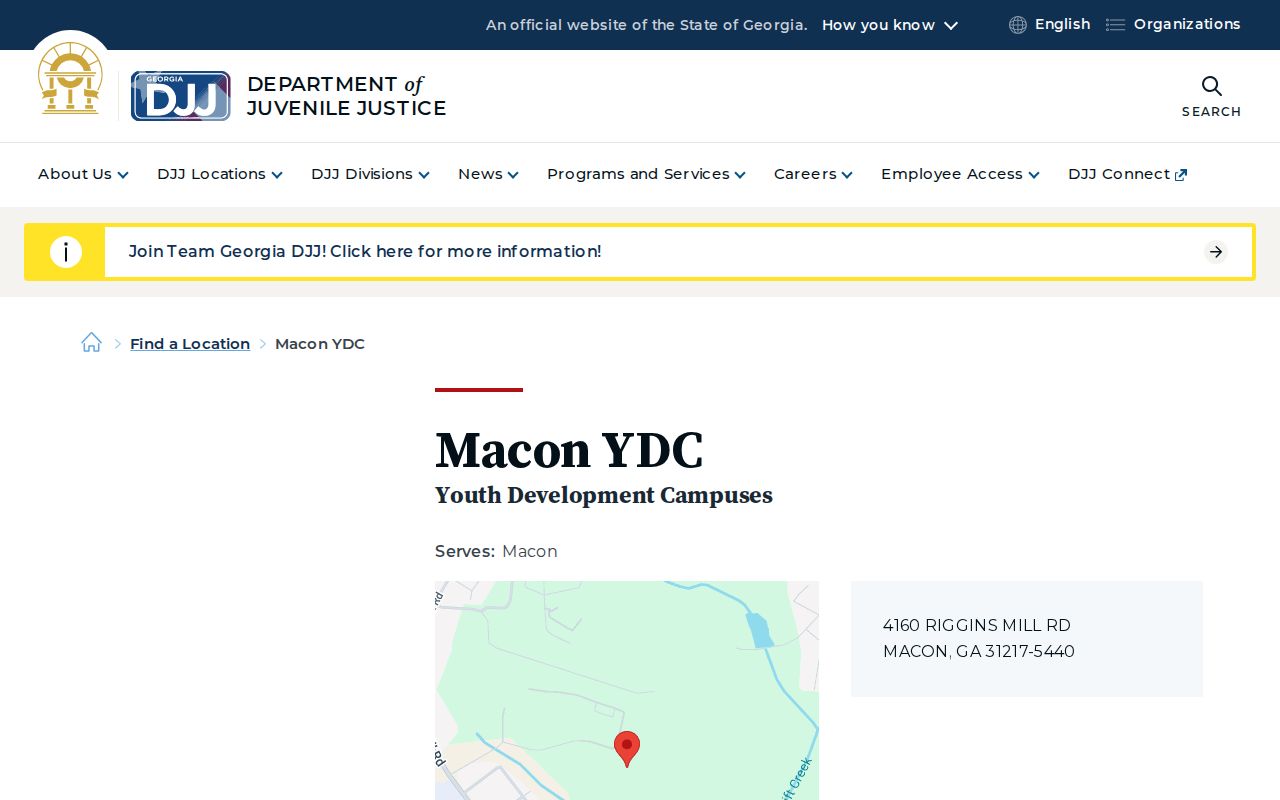
Use the current DJJ page to reach the right office, then follow its identity and authorization process.
Macon Youth Record Limits
Adult jail records are often routed through open-records systems. Juvenile files carry stronger confidentiality. That difference protects youth identity and sensitive case information. It also means an otherwise valid public-record request may not give an unrelated person access to custody or release details.
Authorization can depend on the requester's relationship to the youth, legal role, court authority, and the type of record sought. DJJ or the juvenile court should decide access. Do not ask an adult jail, a state adult-prison office, or an unofficial data source to work around those limits.
- Authorized person
- Someone whom law, court authority, or agency policy permits to receive the information.
- Juvenile disposition
- The court's resolution and ordered response in a youth case.
- Placement
- The setting approved for care, custody, treatment, or supervision.
- Transfer
- Movement to another placement while legal custody may continue.
Adult Searches Do Not Apply
The Bibb County Law Enforcement Center roster covers adult local jail custody. The GDC offender search covers adult state corrections. Macon Youth Development Campus belongs to DJJ. These systems are not interchangeable, even though all can involve a person in government custody within Bibb County.
VINELink coverage also varies by agency and feed. It should not be presented as a guaranteed public youth locator. A general custody notification platform cannot override juvenile confidentiality. Likewise, booking-photo discovery is not an acceptable youth release workflow. The safe and accurate route remains an authorized DJJ or court inquiry.
| System | Use for this campus? |
|---|---|
| Bibb adult jail roster | No |
| GDC adult offender search | No |
| Adult mugshot search | No |
| Authorized DJJ contact | Yes |
| Authorized juvenile-court access | Yes |
About Macon Youth Campus
The campus is a state juvenile facility. Its inclusion among local facilities helps prevent a common search error: treating every custodial site in Macon as an adult jail. The distinction changes the agency, record law, language, and contact path.
The DJJ Youth Development Campus locator provides broader official location context. Its matched capture appears below.
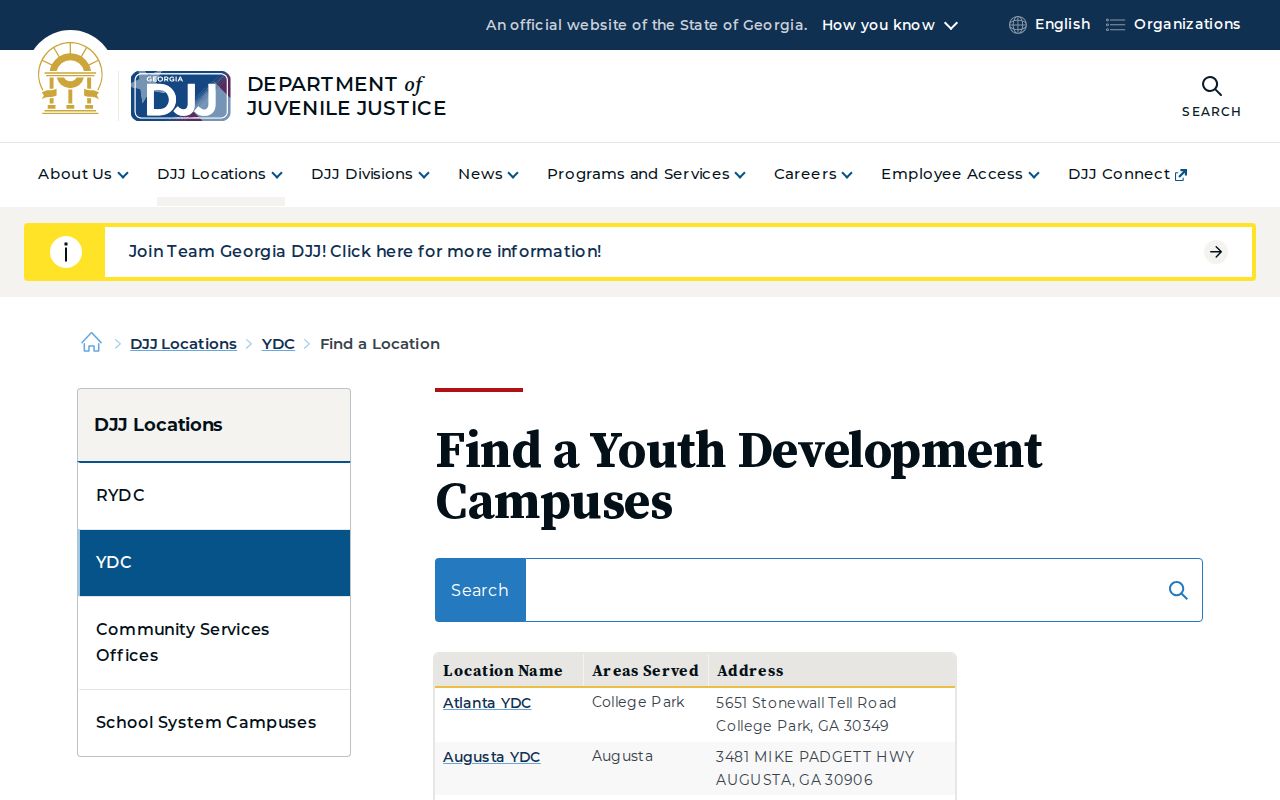
The locator can confirm the agency and current facility entry. It is not a public list of youth or their release dates.
Juvenile Court Release Role
A juvenile court order may control placement, review, supervision, or return. Only the appropriate court and parties with lawful access can explain a specific order. A public adult criminal docket should not be expected to supply the same information. If counsel is involved, counsel can identify the court and lawful request method.
Ask focused questions: whether an order exists, which office holds it, who may receive it, and what proof of identity is needed. Avoid sending sensitive youth information by ordinary email unless the agency instructs that method. Follow the secure intake route supplied by DJJ or the court.
A court-ordered placement can end or change without creating a public adult-style release record. For that reason, the most accurate answer may be provided directly to an authorized person rather than displayed online.
Macon Youth Facility Context
Macon-Bibb public-safety planning may mention detention facilities in local news. Such material can explain infrastructure but cannot verify a youth's identity or release. Use official Macon-Bibb notices only for broad local context. DJJ remains the source for campus operations.
The broader Bibb County released inmate search covers adult sheriff, GDC, federal, and other public channels. Its adult workflows stop at this boundary. When the person is a youth connected to Macon Youth Development Campus, confidentiality and authorization control the next step.
Make a Safe Youth Inquiry
Prepare proof of identity, the requester's relationship or legal authority, the youth's case information if lawfully held, and a clear description of the needed fact. Share only what the authorized office asks for. Do not post the youth's name, alleged conduct, photo, or placement details in public while trying to locate an answer.
If DJJ directs the requester to a court, use that court's approved access process. If the court sends the requester back to DJJ, provide the routing details so staff can identify the correct unit. These steps may take more effort than an adult roster search, but they preserve the legal boundary around juvenile information.